Agatha Christie’s Seven Dials, a three-episode mini-series streaming on Netflix, is a modest murder mystery that draws the viewer into the mechanics of investigation without undue frills or ornamental excess. Eschewing spectacle and narrative gimmickry, the series remains content to operate within the familiar pleasures of deduction, atmosphere, and incremental revelation. It does not aspire to reinvent Christie, nor does it strain for contemporary relevance. Instead, it settles for competence, clarity, and a certain old-fashioned narrative restraint.
Set in 1925, Agatha Christie’s Seven Dials unfolds at a lavish country-house gathering in Chimneys, England. The party is hosted by Sir Oswald Coote (Mark Lewis Jones), an industrialist who runs a chain of steel factories, and his wife, at the home of Lady Caterham (Helena Bonham Carter) and her daughter Eileen (Mia McKenna-Bruce), affectionately known as Bundle. Coote is eager to secure a private understanding with George Lomax (Alex Macqueen), a senior figure in the Foreign Office, who is present at the gathering. Also in attendance are several of Lomax’s colleagues, whose idle bravado leads to a prank aimed at Gerry (Corey Mylchreest), reputedly able to sleep through any disturbance. A number of alarm clocks are hidden in his bedroom, set to ring simultaneously the following morning. As the household assembles for breakfast, the clocks erupt across the house, turning a juvenile joke into the catalyst for far more serious consequences.
Chris Chibnall frames his adaptation within the well-worn conventions of the country-house mystery. A grand gathering, a cast of assorted guests, and a death that occurs quietly during the night. Humour is present but carefully rationed, never allowed to erode the seriousness on which the mystery depends. The investigation proceeds with a deliberate, almost procedural patience, unfolding in steady increments rather than sensational turns. There is no recourse to graphic violence or vulgarity. What the series offers instead is a certain narrative discipline. It adheres to a tone and structure that recall an older tradition of British television drama, where atmosphere, and method are valued above shock or excess.
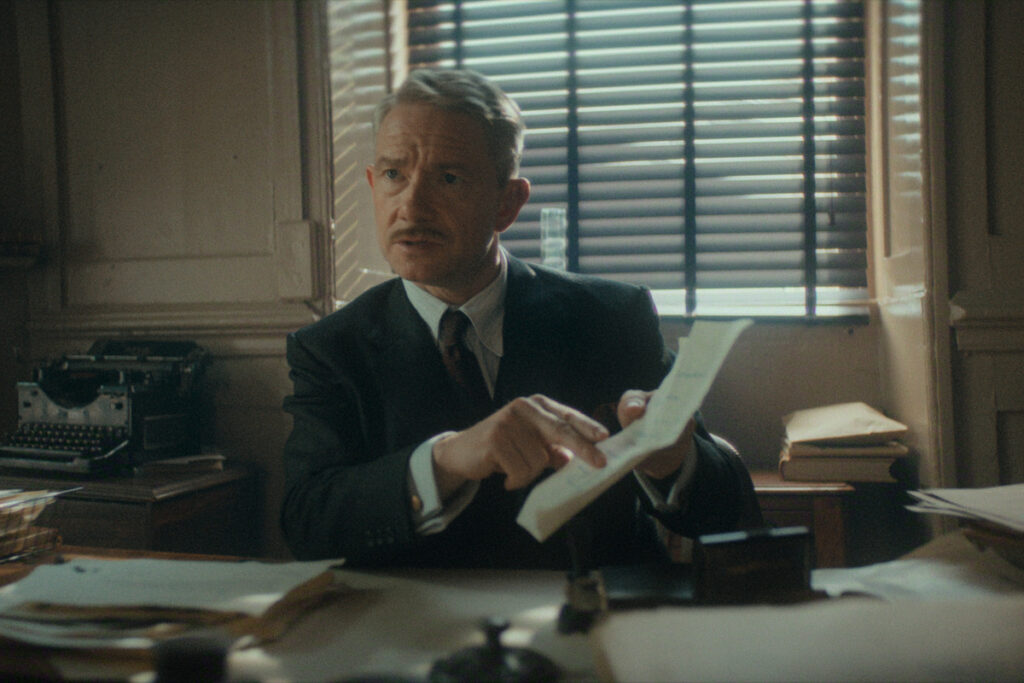
The series is compactly arranged into three episodes of roughly an hour each, a structure that allows the story to unfold without overstaying its welcome. Each episode opens cold and closes on a cliffhanger as devices that have become standard in contemporary streaming drama but are here employed with relative discretion rather than insistence. Bundle’s determination to involve herself in the investigation is presented with a gradualness that feels earned rather than contrived. Her curiosity develops in proportion to what she witnesses and understands, and within those limits her actions remain plausible. The support she receives from Inspector Battle (Martin Freeman) is similarly restrained, lending her access and encouragement without collapsing the necessary professional distance. There are moments when the balance wavers, but the series generally resists turning Bundle into a precocious surrogate detective or reducing Battle to a narrative convenience.
In the final episode, as motives are clarified and the principal players revealed, the series pushes towards an emotional climax. This shift slightly alters its established tone, lending the drama a sharper edge than before. It is also the point at which the plot begins to ask more of the viewer’s indulgence. The resolution is designed to heighten the impact of the ending, but not always persuasively so. Bundle’s sudden proximity to firearms and matters of national security strains credibility, and the enlargement of stakes feels at odds with the modesty that has otherwise served the series well. A deliberate opening is left for continuation, suggesting sequel ambitions. Yet these contrivances are handled with sufficient assurance that the viewer’s suspension of disbelief is not entirely undone. The series manages, in the end, to knit its strands together with enough finesse to preserve coherence, even if conviction wavers.
Mia McKenna-Bruce carries the series with a performance marked by alertness, curiosity, and a quietly persuasive vitality. She gives Bundle a forward momentum that sustains the drama across its three episodes, investing the character’s enthusiasm with enough texture to prevent it from tipping into mere buoyancy. Martin Freeman, as Superintendent Battle, brings an unforced, slightly offbeat authority to the role, playing against the grain of the bluster often associated with screen detectives. Helena Bonham Carter’s Lady Caterham is introduced with the expected hauteur of wealth and position. Yet she allows traces of vulnerability to emerge, suggesting a woman marked by private grief and quiet disappointment. The supporting cast is uniformly competent, maintaining consistency and momentum without drawing undue attention to itself.
Cinematographer Luke Bryant favours clear, unobtrusive framing, allowing scenes to breathe without drawing attention away from narrative or performance. The characters are composed with a classical sense of balance, reinforcing the series’ preference for order and legibility over visual flourish. The period production design, with its orderly interiors by Martin Childs, does not call attention to itself, serving instead the demands of narrative clarity. Emma Oxley’s editing maintains a steady, well-judged rhythm, sustaining momentum without forcing urgency where it is not required. Anne Nikitin’s score is used sparingly, offering tonal support rather than emotional instruction, and reinforcing atmosphere without signalling significance too insistently.
Agatha Christie’s Seven Dials makes no attempt to force its material into contemporary urgency. Its satisfactions lie instead in clarity, tonal control, and performances that serve the story rather than strain against it. Though it occasionally overreaches in its final movements, the series ultimately affirms the enduring appeal of careful construction in an increasingly noisy streaming landscape.