When Wicked premiered, it instantly grabbed a spot in my personal Top 10 for that respective year. Far from the recent revisionist trends that almost always affect films of this scale — and which, frequently, have little or nothing to do with the movie’s intrinsic quality — my admiration for the first chapter remained firm. Therefore, expectations for the sequel-conclusion, Wicked: For Good, were naturally high. Knowing that the general reception had been mostly positive, I chose to ignore the amplifying nature of social media, which, predictably, gives a stage to the most negative takes.
I’ve never had the opportunity to watch the musical on stage, but my familiarity with the respective world is guaranteed, ranging from the classic The Wizard of Oz (1939) to general knowledge of the franchise. I feel, however, fortunate to experience the saga through cinema, my preferred medium for art and entertainment. This perspective prevents any potential distortion of opinion from a prior predisposition, whether from the original tale or the stage play. It’s a relief to be able to enjoy the narrative by its cinematic execution, instead of falling into the trap of criticizing character or plot changes exclusively because they’re different, without first analyzing the merit and function of those same changes on the big screen. The lack of impartiality and the genuine disinterest in seeing an adaptation as anything more than a mere copy of the original continues to be something that deeply confuses me in the panorama of criticism and the general public. An adaptation can and should engage with the source material in new ways, and even if the new vision isn’t preferred, both can coexist and be appreciated. But we move on…
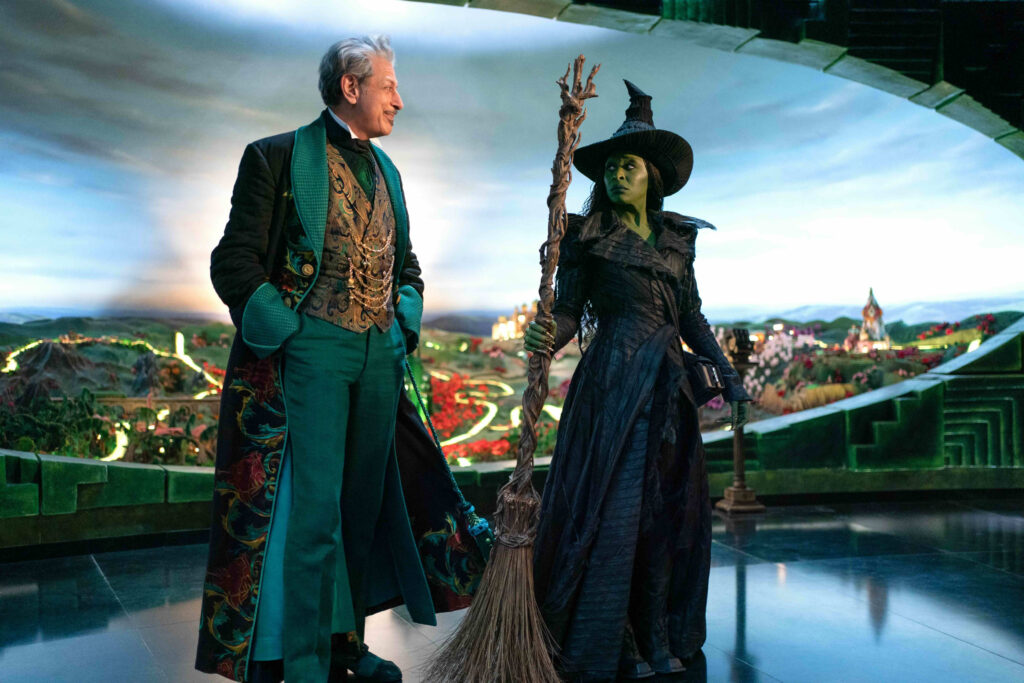
Wicked: For Good is again directed by Jon M. Chu (Crazy Rich Asians) with a screenplay by Winnie Holzman (who also wrote the musical) and Dana Fox (Cruella), picking up the story five years after the end of the initial film. The narrative follows the journey of Elphaba (Cynthia Erivo, Harriet) as she tries to expose the corruption of the Wizard of Oz (Jeff Goldblum, Jurassic Park) and protect the oppressed animals. In contrast, Glinda (Ariana Grande-Butera, Don’t Look Up) is forced to embrace the role of “Glinda the Good,” a public figure who must sacrifice her deep friendship with Elphaba to maintain the illusion of the regime. The second chapter acts partly as a reinterpretation of the classic The Wizard of Oz, introducing Dorothy and her company, while accompanying the evolution of the two protagonists, in a visually stunning spectacle that also features Michelle Yeoh (Everything Everywhere All at Once) and Jonathan Bailey (Jurassic World Rebirth) in the cast.
The emotional core of the entire Wicked saga has always been and continues to be the improbable and deep friendship between Elphaba and Glinda. Wicked: For Good takes this bond to a breaking point and, subsequently, to a devastating and unforgettable declaration. If the inaugural chapter established the foundation of their relationship, this second volume explores the idea that the deepest bonds endure and inspire transformation, even in physical absence. The chemistry between Erivo and Grande is the engine that drives every scene, and it’s in their performances, both dramatic and musical, that the undeniable strength of this movie lies.
Paradoxically, although Erivo is primarily an actress and Grande a singer, I was more impacted by Erivo’s vocal capability and Grande’s dramatic performance. They offer two tremendous displays, filled with passion, emotion, and powerful personifications of everything their characters represent, fluidly incorporating the themes that characterize their respective arcs. Honestly, it would be a shock if anyone even raised a finger at these two actresses, such is their commitment to the project. The emotional climax, culminating in the final song between the two, “For Good” — which is one of the musical high points of the film — is heartbreaking and guaranteed to make the viewer, at the very least, shed a tear. This is where Wicked: For Good achieves its catharsis, reaffirming that Elphaba’s influence on Glinda — teaching her to look beyond appearances — is the true and lasting change that alters the destiny of Oz.
But the sequel isn’t limited to exploring their friendship; the movie shines when addressing what is, perhaps, its most timely and prominent theme: propaganda and manufactured truth. The film demonstrates how the Wizard of Oz masterfully uses fear and misinformation. The narrative is deeply instigating in showing incredibly insane rumors transforming into absolute truths before citizens who never question the source. This is a poignant allegory about how absolute power corrupts and how a panicked population can be easily convinced to hate a designated “other.” In this context, Elphaba, the Wicked Witch of the West, becomes the ideal scapegoat, allowing the Wizard to consolidate his authority.
Along with the political commentary, Wicked: For Good continually questions the price of true kindness and popularity. For Glinda, being “Glinda the Good” requires playing a carefully orchestrated role: maintaining a perfect public image, supporting the Wizard’s deceitful regime, and, most painfully, sacrificing her own convictions and loyalty to Elphaba. This apparent success comes at a high emotional cost, leaving her isolated in a golden cage. In absolute contrast, being “wicked” is, for Elphaba, the supreme act of sacrificial goodness, as she chooses to accept vilification and hatred to fight for justice and truth. Thus, the narrative suggests that true moral integrity is, frequently, incompatible with public acceptance and popularity.
The protagonists’ arcs brilliantly reflect these tensions. Elphaba’s journey is a spiral of isolation and unwavering conviction, taking her from activist to martyr. The protagonist decides to embrace wickedness as a strategic choice, allowing the world to fear her and believe she’s evil, while protecting those she loves and maintaining a form of influence from the shadows. However, her arc culminates in a bitter and existential conclusion: in a world entirely founded on lies, her attempts to do good only resulted in greater harm.
Glinda’s arc, in turn, is that of an insecure opportunist who, gradually, transforms into a leader of genuine ethical substance. Her initial victory is hollow — achieving all the fame, influence, and title she once craved — and is portrayed as a solitary and fraudulent performance. Her process of redemption is slow and painful, beginning when she realizes that the courage shown by Elphaba must now be her own. Glinda ultimately redeems herself through her own sacrifice, cutting off her relationship with the Wizard of Oz’s court, her public happiness, and the opportunity to openly renew her friendship, doing so for the greater good of Oz and, crucially, Elphaba’s safety.
Nevertheless, although Wicked: For Good possesses deep thematic merits, it falls a few steps below the first volume. While the musical numbers are impeccable and the songs “No Good Deed” and “For Good” are high points, the collection itself isn’t as memorable or rich as that of the previous feature film. The overall tonal balance also proves to be more inconsistent, losing much of the layer of humor that surrounded the initial movie due to the drastic shift towards darker topics. Glinda, in particular, has few moments to make the audience laugh — contrary to her hilarious prior performance — and her journey here is more marked by pain and moral compromise.
Wicked: For Good also functions as a kind of retelling, with twists, of the original The Wizard of Oz film from 1939. This is where the narrative becomes a bit more confusing, feeling, at times, forced to move away from what made the previous movie so captivating — the pure focus on the relationship between Elphaba and Glinda and the politics of Oz — to ensure it covers the main The Wizard of Oz story. Some of the additions are genuinely clever and enrich the canonical story, but others cause more conflict, as they drastically alter part of the essence of certain characters — some superficial yet pertinent questions go unanswered, which is a small frustration.
Finally, the sequel is negatively surprising regarding visual effects. Although the problem of the artificial and excessively saturated lighting of the initial feature film is less evident here, some of the animals don’t look as well-integrated, and the Wizard in a younger CGI version is, let’s be honest, a visual nightmare. However, the production and set design continue to be breathtaking, a visual spectacle of colors, shapes, and textures that justifies a trip to the big screen.
Wicked: For Good may not reach the levels of the first film, but it remains a wonderful work of technical excellence and profound emotional impact. The audiovisual spectacle is complemented by the urgency of its social commentary on political propaganda and, most crucially, by the unbreakable heart of its friendship story. Cynthia Erivo and Ariana Grande-Butera cement themselves as the essential figures of this adaptation, elevating the narrative with performances that are, by themselves, the biggest reason for enjoying the movie. It’s a triumphant, devastating, and cathartic conclusion, proving that true goodness doesn’t reside in public reputation, but in the sacrifices made in the name of justice and unconditional love.