The ghost of John Carter returns to haunt Andrew Stanton in his second live-action feature, fourteen years after the 2012 sci-fi epic, which cost over $300 million bombed at the box office. It was a rare misstep for Stanton, whose credits working for Pixar Animation Studios have been stellar, from writing the groundbreaking Toy Story to directing two of the studio’s best animated features: Finding Nemo and WALL-E, both of which went on to clinch the coveted Oscars.
While his upcoming Toy Story 5 this summer remains to be seen whether it’s a worthy entry or a desperate cash grab riding on nostalgia and brand recognition, here is Stanton unexpectedly hits an all-time low in Hulu’s straight-to-streaming sci-fi drama, In the Blink of an Eye. On paper, the underlying theme of shared humanity spanning across generations from the prehistoric era to the present day and the future is right in Stanton’s wheelhouse, especially given his robust experience in crafting genuine human stories seen in the best of his Pixar movies. But how ironic it is that his latest live-action attempt loses sight of what makes a story like this resonant to the viewers.
Working from Spaceman’s Colby Day’s screenplay, which landed on 2016’s Black List, the story follows three interconnected stories that begin with the Neanderthal family at 45,000 B.C.E., focusing on a caveman named Thorn (Jorge Vargas) and his family – pregnant wife Hera (Tanaya Beatty), teenage daughter Lark (Skywalker Hughes) and their newborn son. They live in solitude somewhere on a beach, and when they speak in a foreign language, there’s no English subtitle appears on the screen, but rest assured, their story is universal, making it easier to understand.
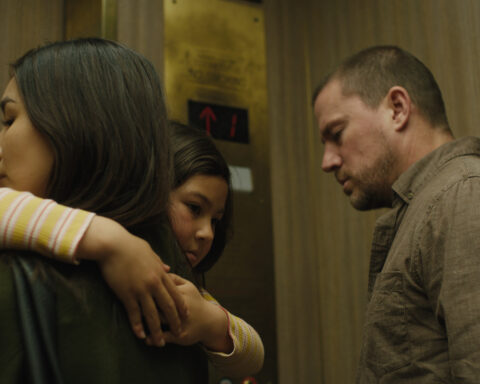
Personally, I find the Neanderthal family segment emphasizing on the minimalist storytelling, coupled with Ole Brett Birkeland’s gorgeous nighttime and daytime cinematography shot on the rugged British Columbia locations, works the best to an extent. But the two other segments feel like a chore to sit through, beginning with the 2025-set present time, where the story follows Claire (Rashida Jones), an anthropology researcher whose relationship with her partner Greg (Daveed Diggs) is merely restricted to sex at first. However, their initial carnal pleasure slowly blossoms into a mutually romantic connection. Then, things become complicated when her mother is gravely ill. It’s hard for me to root for Claire’s plight juggling between dealing with her sick mother and her relationship with Greg. The main problem here lies in the lack of emotional weight, resulting in watching her segment unfold like a tedious slog struggling to reach the finish line.
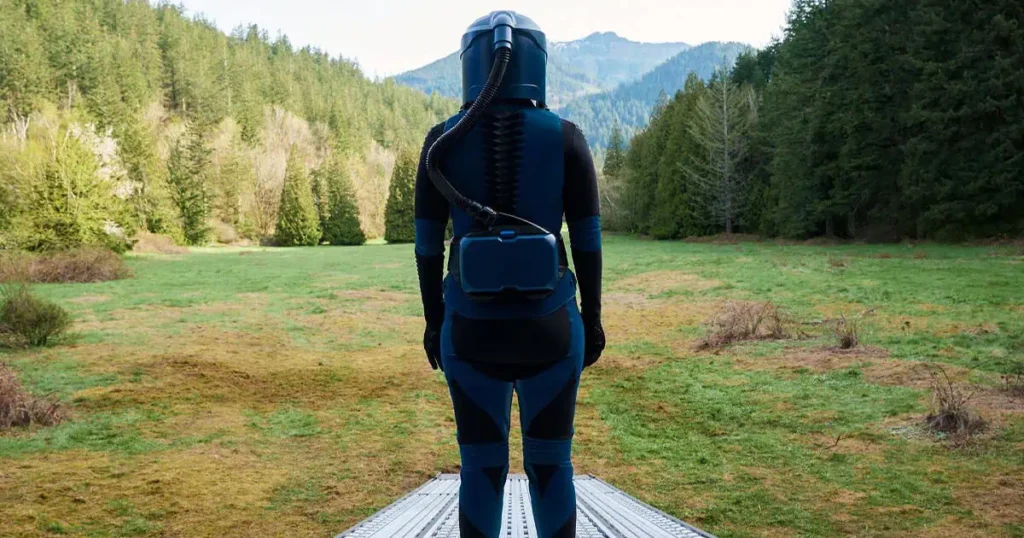
The third segment, set in the futuristic 2417, involves Coakley (Kate McKinnon), a longevity-enhanced pilot on a lone mission to transport human embryos to a planet called Kepler-16b for the purpose of population. Her only companion to talk to is an A.I. dubbed ROSCO (voiced by Rhona Rees). I was expecting a dynamic between Coakley and ROSCO, but their chemistry comes across as hollow, and it doesn’t help that McKinnon is woefully miscast for such a role. She just doesn’t have the necessary dramatic flair to play a crucial character in charge of populating a planet, although the subsequent setback revolving around a mysterious virus threatens to spread across the spaceship, including the oxygen supply that is vital to keep everyone on board alive. I also can’t help but every time I look at her trying to maintain a certain sense of composure, she’s going to break character anytime soon by falling back into her comedic comfort zone. Which she did at one point for a brief moment, even though it was intentionally meant for her to act that way.
Stanton tells his story by incorporating match cuts that interweaves these three segments back and forth while highlighting relevant themes of hope, mortality and human connection along the way. But what should have been a well-meaning sci-fi drama is sadly hampered by Stanton’s surprisingly surface-level storytelling. Save for the Neanderthal family segment, everything here is perfunctory to the point I find the seemingly short 94 minutes feels like it overstays its welcome long before it ends.
Technically speaking, In the Blink of an Eye boasts Thomas Newman’s beautifully elegiac score, which is among the saving grace here, and so are the seamless CGI and production design. Too bad these aren’t enough to offset most of the movie’s glaring flaws, especially since it fails to generate interest and, above all, both emotional and dramatic stakes.