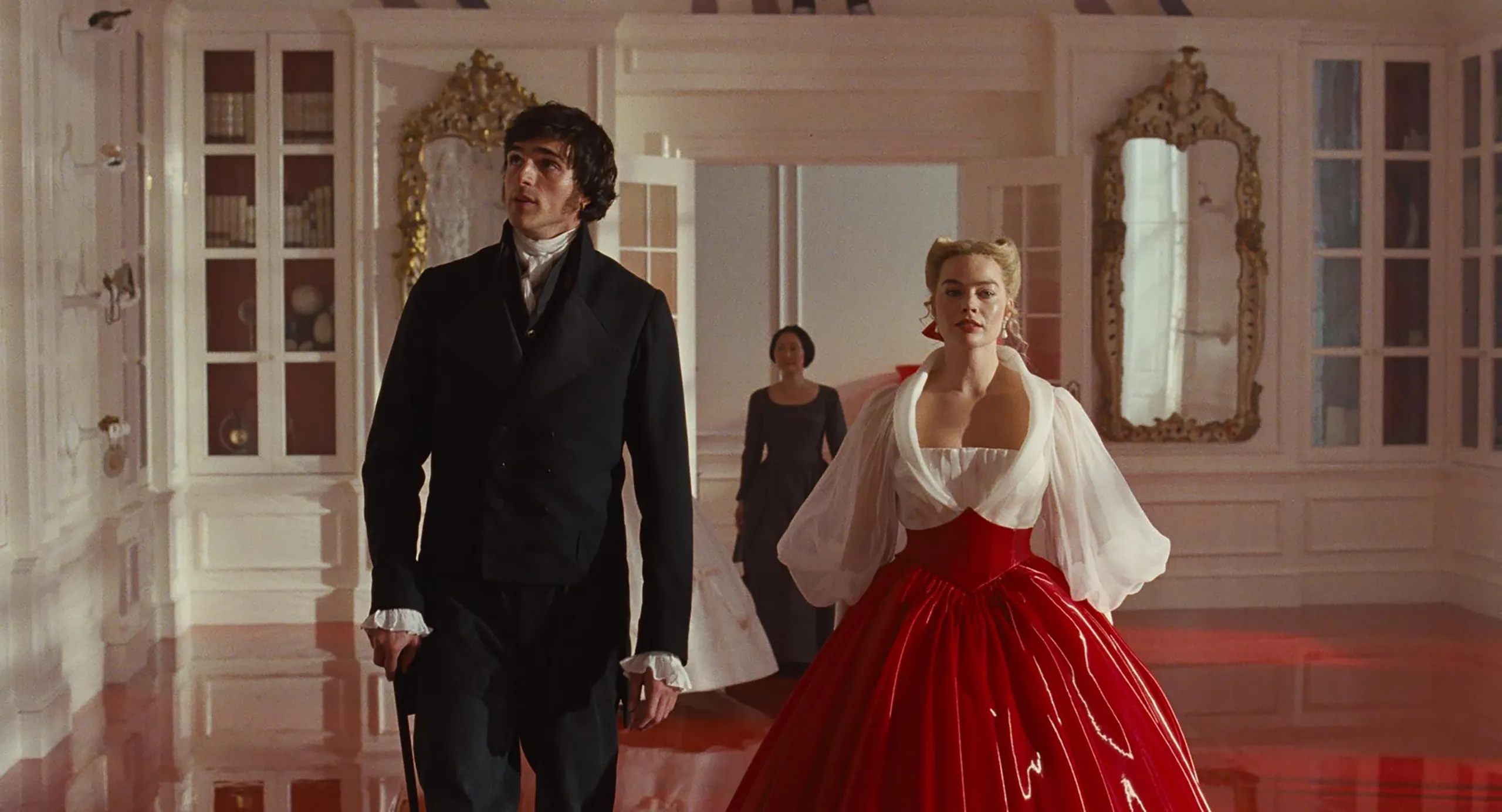
It’s unbridled lust over love in Emerald Fennell‘s “reimagining” of Emily Brontë’s 1847 novel, one of the most frequently adapted films ever made. Instead of Wuthering Heights, it’s “Wuthering Heights”, emphasizing the quotation marks that are deliberately added since Fennel has set the record isn’t aiming for a faithful adaptation. As bold as it may sound, she doesn’t abandon some of the basis of its source material. The story is still about two conflicted lovers — Catherine a.k.a Cathy (Margot Robbie) and Heathcliff (Jacob Elordi) — chronicling from their childhood era, where they love to spend time together (Charlotte Mellington and Owen Cooper play the younger versions) and making troubles. Cathy is a spoilt daughter of Mr. Earnshaw (Martin Clunes), an alcoholic and a gambling addict who has taken in the illiterate and dirty-looking orphan Heathcliff. Cathy is excited to have him around, and their romantic tension is already hinting at between the two of them.
The story then skips to a few years later, with the two already reaching adulthood. That same romantic spark remains intact, but neither of them wanted to make a move. Their class differences prevent them from getting together as a couple, particularly from Cathy’s point of view. It doesn’t help when the presence of the wealthy Edgar (Shazad Latif) and his sister Isabella (Alison Oliver) subsequently catches Cathy’s attention. Marrying Edgar would mean she doesn’t have to worry about living a poverty-stricken life, especially given that her uncontrollable father keeps gambling the money away. But doing so also means she must give up on Heathcliff, even though deep down, her heart is still yearning for him. Unfortunately, Heathcliff is left devastated upon overhearing about Cathy’s marriage and decides to leave.
Years after Cathy has married and lives a comfortable yet luxurious life with Edgar and Isabella, it looks as if she moves on until Heathcliff’s unexpected return leaves her overwhelmed with mixed feelings. Heathcliff is no longer the same unkempt person she once knew in the past, but rather a completely changed man looking all proper with a gentleman’s demeanor. I remember watching two of the many Wuthering Heights movies: the William Wyler‘s 1939 Oscar-nominated black and white classic (still the best in my opinion) and the 1992 version starring then-newcomer Ralph Fiennes as Heathcliff, where the latter was notable for being the rare film adaptation that covers the first and second half of the book, albeit in a condensed narrative structure.
By comparison, Fennell’s version sees the writer-director eschewing the novel’s critique of the social class system during the more rigid 18th-century England in favor of a stripped-down approach focusing on the emotional and physical longing between Cathy and Heathcliff. The latter’s return has subsequently re-ignited Cathy’s passion, resulting in their forbidden affair. The sex is intense, and every shot is meticulously framed with Linus Sandgren‘s moody lensing, and Suzie Davies‘ opulent production design makes the movie such a cinematic feast for the eyes. Fennell has undoubtedly prioritized a lot on the visual front, easily one of the best-looking movies so far in 2026.
Robbie and Elordi are an attractive on-screen couple, but beyond watching them trying their best to play illicit lovers hungry for each other, I find their emotions are lacking. Like an empty shell where it’s hard for me to invest in the plight of their relationship. It was the way Fennell chose to approach the movie with her style-over-substance direction. To the point it makes me feel like I’m watching a feature-length music video, and the fact that Charli XCX is enlisted for the soundtrack ironically fits the criteria.
The movie is also overlong, clocking in at a bloated 136 minutes. For a movie that zeroes in primarily on the two star-crossed lovers’ lusting and loathing for each other with the recurring I-love-you, I-hate-you vibes, it feels like a self-indulgent excess that begs for a much-needed tightening on the editing side. For the supporting cast, the typically reliable Hong Chau brings subtlety to her role as Nelly, who serves as a booksmart housekeeper and also a companion for Cathy. But it was surprisingly Alison Oliver, who steals the show as Isabella, first introducing her as a meek and cheerfully naïve young woman to someone who subsequently loses her dignity, especially after she is under the influence of the manipulative Heathcliff, much later in the movie.
So much for the big hype that’s been built up leading to the release, and what I have here marks a rare miss for Fennell, whose otherwise previous two intriguingly subversive movies, Promising Young Woman and Saltburn, firmly established the directorial prowess of this multihyphenate English actress and filmmaker.