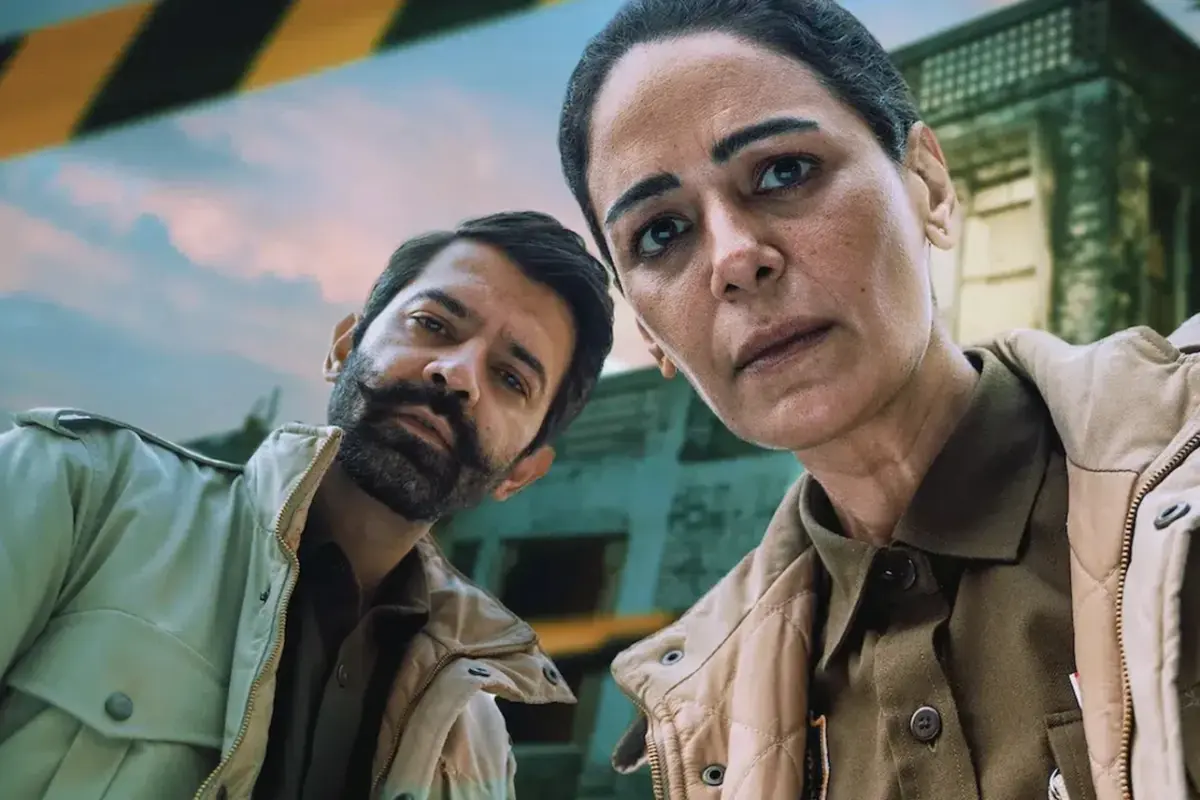
Kohrra Season 2, currently streaming on Netflix, returns to the terrain of murder and investigation, but its real preoccupation lies elsewhere. As the inquiry unfolds, the series steadily exposes the prejudices, biases, and moral rot sustained by privilege in a society deeply entrenched in hierarchy and silence. With Sudip Sharma, writer of the first season, this time also assuming directorial responsibilities alongside Faisal Rahman, the new season crafts a narrative that is gripping without being sensational, attentive to the shadows that violence casts long before the crime itself occurs.
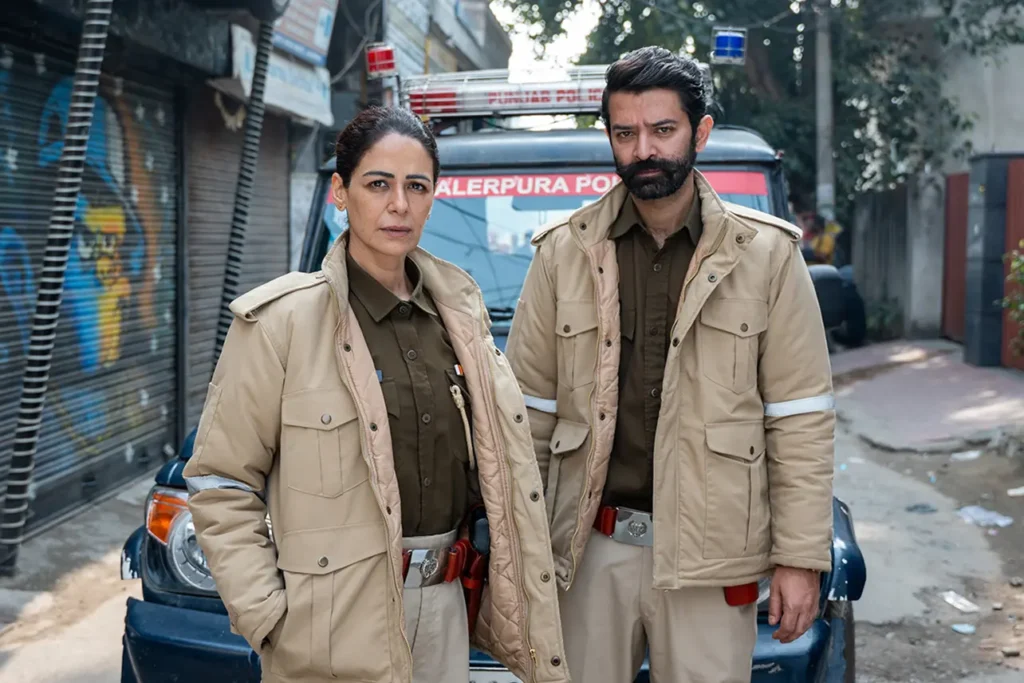
Set in the town of Dalerpura, Punjab, Kohrra Season 2 opens with the brutal discovery of Preet (Pooja Bhamrrah), an NRI woman found impaled on a grass cutter inside a barn on her brother Baljinder’s (Anurag Arora) property. Preet had been living there with her widowed mother, sister-in-law, and two young daughters, estranged from her America-settled husband Tarsem (Rannvijay Singha). The investigation is assigned to SI Dhanwant Kaur (Mona Singh), assisted by ASI Amarpal Garundi (Barun Sobti), now posted to the town. As they navigate the procedural demands of the case and the shifting dynamics within the force, the inquiry gradually moves beyond the mechanics of murder to examine the strained relationships surrounding it.
The continuity between the two seasons rests largely on ASI Amarpal Garundi, now transferred to another police station, carrying with him a residue of unresolved strain. Once again, the victim is an NRI; once again, the setting is a small Punjabi town; and once again, the crime opens onto deeper social fault lines.And, in keeping with Sudip Sharma’s battered cop universe, the investigators are not spared: this time, both officers find themselves bruised, professionally and personally, by the forces they confront. Migration, property, gender, and hierarchy form the unspoken architecture of the narrative. The investigation reveals less about criminal ingenuity than about ordinary entitlement and inherited prejudice.The tempo is measured, almost severe in its refusal of spectacle. The series declines the temptations of melodrama or kinetic excess, favouring instead a procedural steadiness that approximates lived time. Its cliffhangers are functional rather than flamboyant. It is structured to extend inquiry rather than manufacture hysteria. Written by Gunjit Chopra, Diggi Sisodia, and Sudip Sharma, the season remains preoccupied with human frailty. Violence here is not extraordinary; it is incremental, born of wounded pride, thwarted aspiration, and the quiet corrosion of relationships. The writing resists polemic. The result is a work that trusts accumulation over shock, and observation over proclamation.
The series is attentive to the quieter malices that sustain violence long before blood is shed. Patriarchal bias operates not as rhetoric but as habit: a daughter’s claim to her father’s property is treated as transgression; during routine questioning, a husband answers on behalf of his wife; the refrain that a woman “must know her place” surfaces with weary predictability. There are intimations of bonded labour, of masters who imagine that feeding the exploited is an act of benevolence rather than control. A wife may confess a troubled past; a husband, bound by fear, hesitates to do the same. The narrative also gestures towards contemporary Punjab’s performance culture — music videos, reels, the cultivation of image — and the uneasy consolation it offers. A father reassures himself that his son’s pursuit of music is virtue enough, if only because it stands in contrast to the state’s endemic drug crisis. Elsewhere, physical power and muscular display intrude upon a land dispute, masculinity asserting itself as argument. These strands are not appended as social commentary but woven into the fabric of the plot.
The season opens with a mother discovering her daughter’s body, pierced and left in a cowshed. It is an image at once brutal and curiously intimate. From this point onward, the motif of parenthood, its presence, its absence, its failure, recurs with quiet insistence. Children are lost, longed for, concealed, or instrumentalised. The crime itself seems less an isolated act than the consequence of generational fracture. Both principal investigators are themselves entangled in the question of parenthood. SI Dhanwant Kaur, having lost a child in an accident, now seeks IVF treatment, desiring motherhood while withholding physical intimacy from her husband Jagdish (Pradhuman Singh). Garundi, meanwhile, remains morally compromised by his past affair with his sister-in-law, now pregnant, who has been brought into his household in her husband’s absence, a decision taken by his wife, Silky (Muskan Arora), that deepens the domestic strain. The domestic arrangement produces not melodrama but a low, persistent tension where guilt is made spatial. Elsewhere, a young migrant from Jharkhand, Arun (Prayrak Mehta), searches for his father armed only with a faded wedding photograph of his parents as an identity reduced to a fragile relic. In another strand, a mother, anxious about her daughter’s future, engineers a plan whose calculation borders on cruelty. Across these narratives, parenthood is neither sanctified nor sentimentalised. It is at once a weight to carry, a longing to fulfil, a means of control, and, at times, a self-deception.
In any whodunit, the revelation must draw the scattered threads into a persuasive whole. Here, the unmasking does not entirely achieve that closure.The final turn feels less inevitable than convenient, as if the narrative has gently veered off course to meet its own deadline. After a patient build-up, the resolution appears somewhat exhausted rather than fully earned. Familiar procedural devices surface. The case on the verge of being transferred, the late surge toward clarity — and one exchange, in which the female protagonist must protest the routine charge of “emotionality,” feels obligatory. Yet these are blemishes rather than fractures. The series is less invested in the ingenuity of the culprit than in the emotional sediment left behind by the crime. It is the human drama — the bruised marriages, the fragile reconciliations, the grudging solidarities — that assumes primacy over the mechanics of detection. A wife absorbing the pent-up confessions of her husband in rehabilitation; an estranged elder brother calling the younger sibling he has quarrelled with when crisis intervenes. On paper such moments risk melodrama. On screen, however, they are handled with calibrated restraint, keeping them from sliding into emotional indulgence.Kohrra ultimately privileges interior weather over narrative fireworks. The mystery may not close with complete satisfaction. But the emotional aftertaste lingers. It is subdued, uneasy, and, in its own way, persuasive.
Mona Singh’s Dhanwant Kaur is drawn with admirable restraint. She plays the officer as someone who privileges duty over private disarray, allowing grief to register in fleeting gestures rather than demonstrative breakdowns. As a mother marked by loss, a wife negotiating the fragility of her marriage, and an investigator pressed forward by professional obligation, Singh avoids overt display. The performance is internalised, measured, and quietly authoritative. Barun Sobti’s Garundi, by contrast, operates at a similar emotional temperature. Restless, impulsive, and morally compromised, he embodies a man perpetually at odds with himself. Sobti lends the character urgency without tipping into excess. The personal turbulence never entirely eclipses the procedural focus. If Singh’s presence is composed, Sobti’s is kinetic, and the friction between the two lends the series much of its dramatic charge. Prayrak Mehta, as the migrant Arun, brings a disarming vulnerability. There is an unvarnished quality to his performance that resists theatricality, and conveyed with unaffected simplicity. The supporting cast — Anurag Arora, Muskan Arora, Ekta Sodhi, Pradhuman Singh, Rannvijay Singha and others — sustain the texture of their characters without strain.
Isshaan Ghosh’s cinematography favours muted palettes and lived-in interiors, framing characters within spaces that feel occupied rather than composed. Faces are often held in stillness, allowing silence to do its work. Sanyukta Kaza’s editing maintains the series’ deliberate cadence, where scenes are given room to unfold, mirroring the rhythms of the lives observed. Vinit D’Souza’s sound design is equally restrained, attentive to ambient texture without drawing attention to itself. The use of Sukhbir’s Ishq Tera Tadpave — shifting from non-diegetic pulse to diegetic presence during a chase — is deft rather than decorative. The background score by Naren Chandavarkar and Benedict Taylor remains spare, shading tension without insisting upon it.
Whether Kohrra Season 1 surpasses the second is, finally, beside the point. What endures is its commitment to measured, character-driven drama, the sort streaming platforms might have mastered long ago had they not pursued novelty so restlessly. This season uses the freedoms of the format without lapsing into indulgence. If another chapter follows, it will justify the wait.