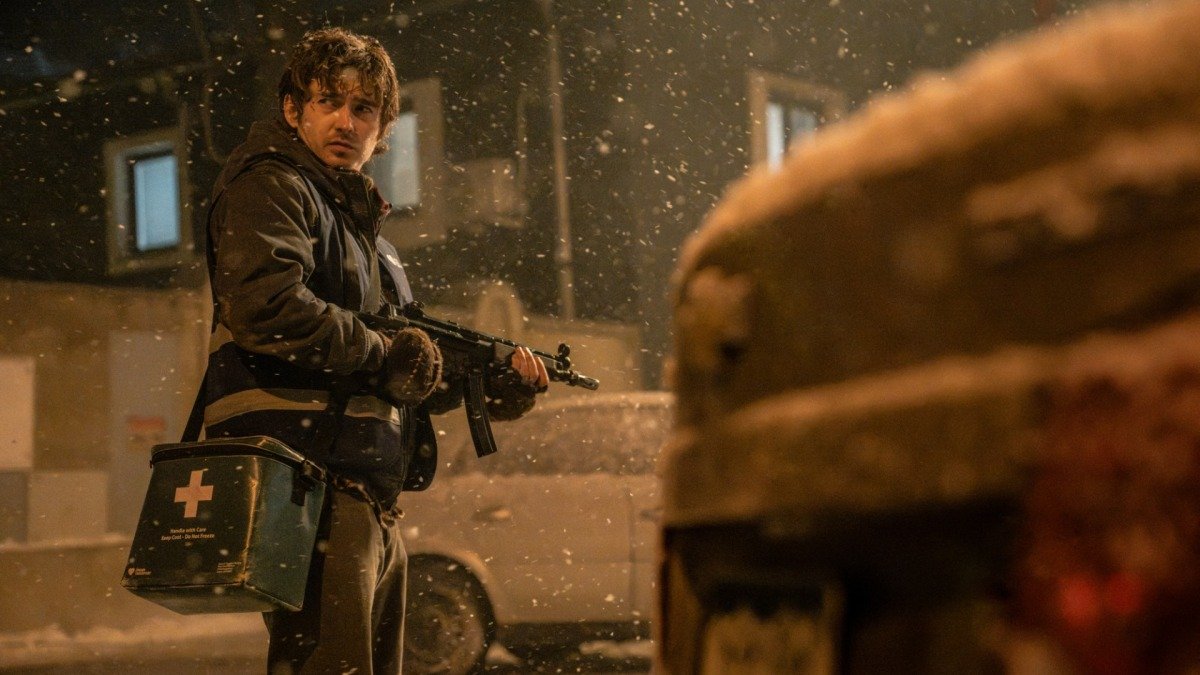
The fact that Zach Cregger goes against the grain by not sticking to a faithful adaptation of the Resident Evil games sounds as if he’s shooting himself in the foot. Besides, fans of the popular action-horror game franchise have been longing for a film adaptation that’s worth the wait, especially after the six Milla Jovovich-led movies and the 2021 reboot didn’t exactly fulfill expectations. I was skeptical that Cregger’s decision to prioritize a new story over telling or expanding the existing lore would easily mark his first directorial misfire after his one-two punch of Barbarian and Weapons.
He even eschews established characters from the games like Leon S. Kennedy, Jill Valentine, and Ada Wong in favor of a new protagonist. One that isn’t well-trained in tactical combat or even as resourceful as Claire Redfield, but rather an everyman protagonist who’s clueless about everything that’s been going on. The person in question is Bryan (Austin Abrams), a medical courier who has just completed his final delivery of the night to a hospital and is about to head home.
He already has a personal problem to settle with his girlfriend, only to have a nurse stop him for an urgent delivery. So urgent that Bryan would receive double pay if he took the job: Deliver a package to the hospital in Raccoon City. It’s a long journey, plus the blizzard night makes driving on the icy road significantly challenging. But since Bryan needs the money badly, he ends up doing it anyway. Of course, you know where this is going.
Clocking in at just 90 minutes, Cregger and co-writer Shay Hatten favor economic storytelling from the start before going straight for the jugular, highlighting Bryan’s subsequent encounter with a woman appearing in the middle of an icy road. This leads to an inevitable accident, but the woman is somehow alive. What follows is a series of dire scenarios that Cregger boldly incorporates dread-inducing tension and dissociative humor without resorting to over-the-top results, turning Resident Evil into an unintentionally laughable affair.
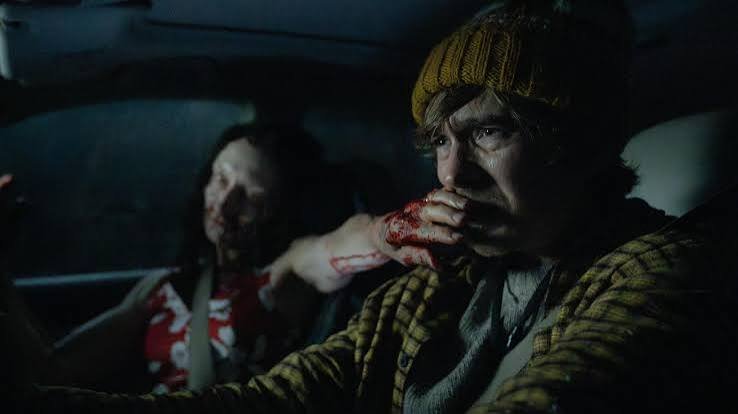
The added comedy mirrors Bryan’s coping mechanism through constant swearing and dealing with wildly absurd situations as the movie progresses. His incompetence and lackluster survival skills are highly relatable for someone like Bryan, and Cregger does a good job of utilizing him as an effective audience surrogate, even transplanting the psychological experience of how a panicked first-time player would react when playing the game. For instance, Bryan tries to figure out how to get the safety off a pistol while being chased by the woman, who later turns into an uncontrollable, zombie-like raging maniac.
Cregger also refuses to give his character a typical zero-to-hero arc, the kind where the protagonist would reach an inner confidence at some point and become competent in eliminating the zombies and monsters like a pro. Instead, Cregger insists on maintaining Bryan’s inept way of survival, either by dumb luck or a fight-or-flight response. Austin Abrams embodies such a character that makes me root for his ordeal, thanks to the actor’s right balance of grounded realism and everyday charm without coming across as overwhelming comic relief.
For a video game movie that isn’t faithful to the source material, Cregger doesn’t bastardize the Resident Evil brand recognition since he still retains the core gameplay mechanics, namely emulating the game’s deliberate camerawork between POV and third-person perspective. He doesn’t shy away from embracing repulsive body-horror elements, notably the introduction of mutated human zombies merging into grotesque spider-like extremities that combine practical effects and CGI.
The sound design is equally top-notch, capturing the claustrophobic tension of the game, and Cregger doesn’t forget to throw in jump scares that are thankfully well-earned rather than falling prey to cheap tactics just for the sake of startling the audience. Resident Evil deserves mention for co-composers Hays and Ryan Holladay, whose synth- and brass-heavy score brings an escalating sense of unease and anxiety throughout the movie.
Kudos also goes to Dariusz Wolski’s atmospheric nighttime cinematography and gritty lighting, who made good use of the wider aspect ratio designed for IMAX that feels and looks immersive yet palpable. The only gripe here is the rushed third act in the hospital, lacking the psychological precision of what comes before.
Still, the shortcomings don’t deter me from enjoying Resident Evil, easily one of the best video game-to-film adaptations.