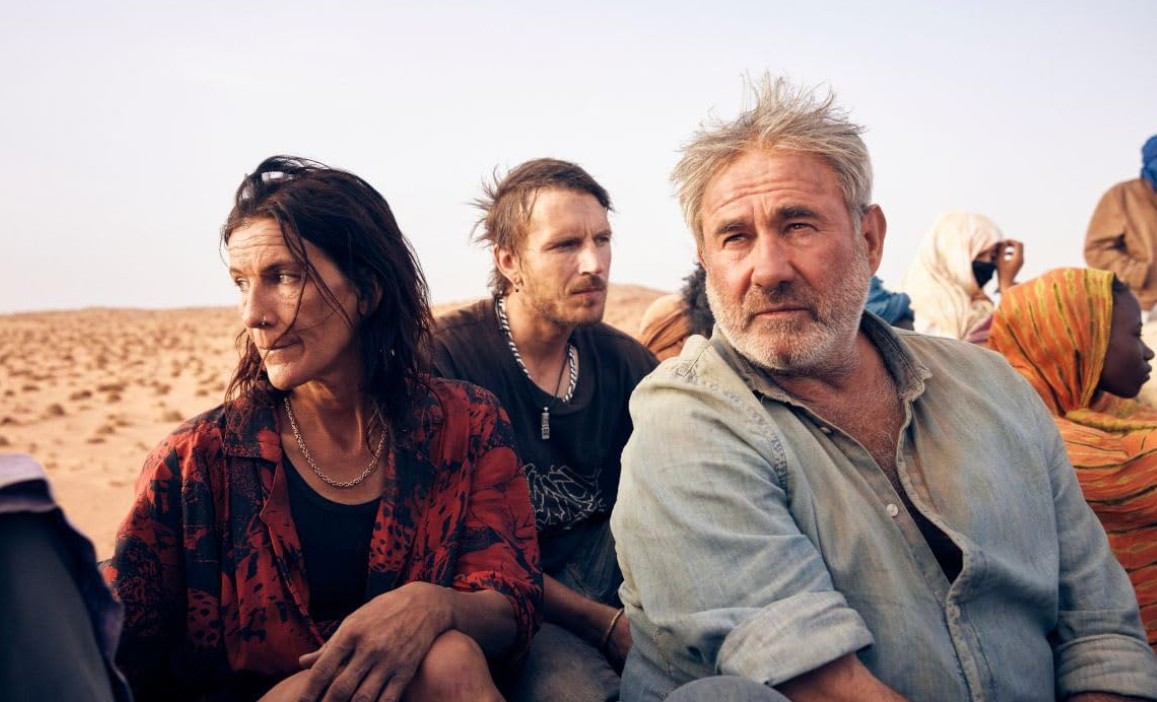
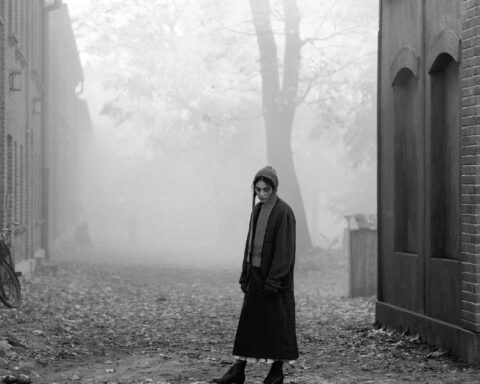
In Sirat, a disparate group of travelers attempt to cross a desolate stretch of the Sahara, a landscape so vast and indifferent it seems to exist outside ordinary time. What begins as a trek across hostile terrain gradually assumes the shape of a moral passage. Governed by chance, and fate, unpredictable forces preside over their progress that erodes their resolve until bearing itself feels abstract. Óliver Laxe’s directorial control denies comfort and bends both characters and viewers to ordeals that feel less staged than inescapable.
Luis (Sergi López) arrives at an illicit rave in southern Morocco with his young son, Esteban (Bruno Núñez Arjona), and their dog, Pipa, hoping to trace his missing daughter, Mar. It is a makeshift enclave of European revelers sustained by music, and narcotics. The illusion of autonomy feels precarious from the outset, and the landscape indifferent to human intention. Soon soldiers abruptly dispersed the gathering amid reports of an escalating geopolitical crisis. As whispers circulate of another party deeper in the desert near the Mauritanian border, a small faction breaks away. Luis follows them. What begins as paternal resolve gradually takes on a more troubling aspect. Gradually it becomes less of a search than a refusal, or perhaps, an inability to retreat.
Laxe structures the film around gradual depletion. Vehicles fail, supplies thin out, distances stretch. The travelers Bigui (Richard Bellamy), Stef (Stefania Gadda), Josh (Joshua Liam Henderson), Tonin (Tonin Janvier) and Jade (Jade Oukid) are not romanticized as free spirits nor condemned as naïve intruders. Instead, they function as bodies in motion, linked by necessity rather than ideology. Brief moments of warmth emerge through shared meals, improvised music, collective labor as they cross a river or free a stuck vehicle. These moments of comfort are consciously presented as fleeting, and never solid enough to provide lasting reassurance. The filmmaker does not allow intimacy to harden into reassurance. The journey is structured as a slow abrasion. The desert does not merely test them physically; it dissolves their assumptions about solidarity and agency. Mishaps accumulate with unnerving inevitability. Catastrophes occur without emphasis or release, often interrupting moments of apparent relief. There is no explanatory backstory for the geopolitical crisis that seeps in via radio broadcasts, nor is the infinite landscape framed as a symbolic testing ground in any conventional sense.
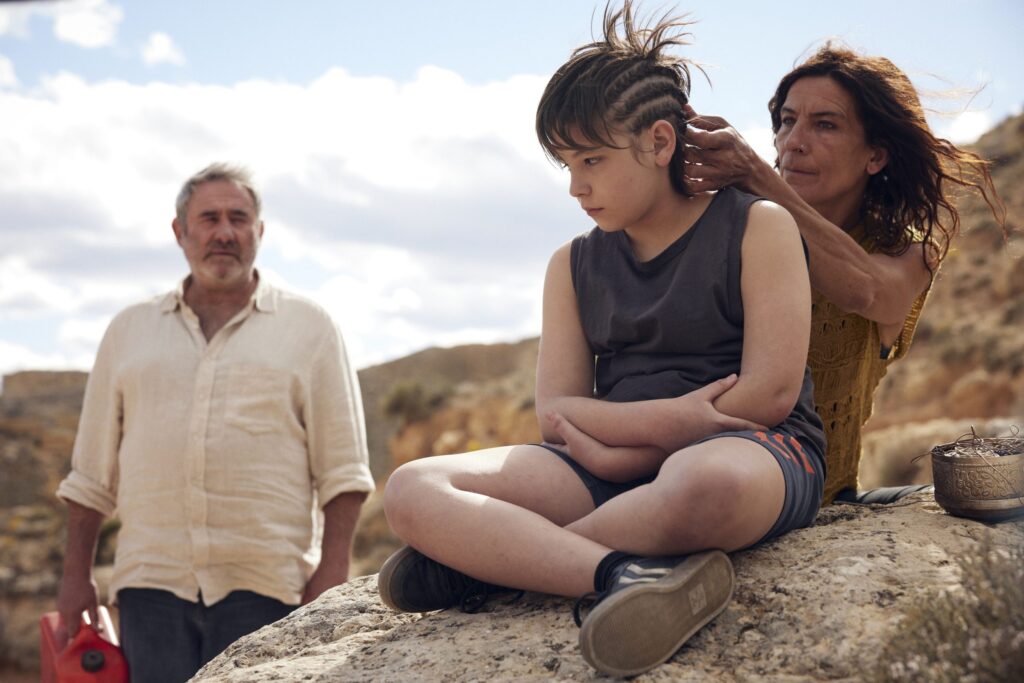
The decisive rupture comes on a mountain pass, where a sudden accident alters the course of the journey. Staged without melodrama, the moment is all the more bracing. The search for Mar recedes into abstraction, and survival is no longer a goal but a condition imposed on those left behind. As the film moves toward its climax, it adopts a stark, near-surreal logic that clarifies Laxe’s worldview. Progress emerges as a comforting fiction. A tender, improvised musical interlude briefly suggests renewed cohesion, only to collapse into catastrophe. In the minefield that follows, fate turns on unseen contingencies — courage offers no immunity, fear no warning — and even the idea of forward movement becomes suspect. Laxe and his co-writer Santiago Fillol do not ask what his characters learn from suffering, only how much can be absorbed before endurance itself becomes meaningless.
Formally, Sirat is rigorous without any ostentation. Mauro Herce photographs the desert at scale but without romantic flourish. Figures are often dwarfed within the frame, observed rather than psychologically penetrated. The editing by Cristóbal Fernández avoids sentimental embellishment where scenes end because they must, not because they resolve. Sound design by Laia Casanovas and music by Kangding Ray form the film’s nervous system, generating a subdued, hypnotic rhythm. The rave’s electronic throb, once communal, resurfaces later in diminished, faintly menacing form.
Performances are uniformly controlled, shorn of expressive excess. The actors emote less than endure, and the film draws its force from that restraint. Sergi López anchors the drama with a study in compression. His Luis communicates fatigue, bewilderment and stubborn resolve in increments so slight they scarcely resemble performance in the conventional sense. He is surrounded by largely non-professional actors whose unevenness Laxe turns to advantage. The group never settles into a cohesive ensemble. They remain figures bound by circumstance rather than affinity, their hedonism neither ridiculed nor romanticised.
If Sirat finally feels severe, it is because it declines transcendence. There is no catharsis, only continuation. It demands patience and tolerance for narrative negation. The closing images, with survivors clinging to the roof of a freight train, suggest not liberation but drift. It has been recognised accordingly, receiving the Jury Prize at the Cannes Film Festival, multiple honours at the European Film Awards, and Academy Award nominations including Best International Feature and Best Sound. The accolades acknowledge a work of uncommon severity.
Now streaming on Mubi, Sirat is not a consoling experience. It is, however, a considered one.