I must confess Roofman was yet another festival title I hadn’t set great expectations for, knowing only that Channing Tatum (Magic Mike) was in the cast. I had no idea about the plot, the true story it was based on, or the tone that director Derek Cianfrance (Blue Valentine) would lend to the narrative. As such, I wasn’t expecting to have so much fun or to leave the screening room with my head buzzing with such interesting moral dilemmas. Ultimately, it turned out to be a very pleasant surprise — it’s funny, but also deeply captivating and surprisingly emotional.
Roofman is written by Derek Cianfrance and Kirt Gunn, directed by the former, and recounts the unbelievable true story of Jeffrey Manchester. The film follows Jeffrey (Tatum), an ex-military and struggling father who transforms into the notorious ‘Roofman’ by robbing McDonald’s through holes he cuts in their roofs. After escaping prison, his narrative arc becomes even more bizarre and fascinating: he secretly lives inside a Toys “R” Us store for six months, surviving undetected while planning his next moves. It’s during this period that he falls for Leigh (Kirsten Dunst, The Power of the Dog), a divorced mother drawn to his undeniable charm. As his criminal past and double life begin to unravel, the narrative transforms into a game of cat and mouse that’s as moving as it’s suspenseful.
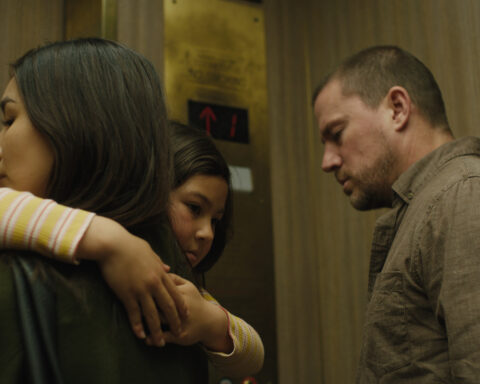
The surprising chemistry between Tatum and Dunst is, by far, one of Roofman‘s greatest strengths. I never thought I’d see this duo work so well as a couple on the big screen, but what they achieve together is remarkable. They both deliver sublime performances that beautifully mirror their distinct yet commonly grounded arcs. On one hand, Tatum’s character desperately tries to save his relationship with his original family through questionable means; on the other, Dunst’s character tries to navigate the family dynamics of a single mother with two daughters, one of whom is constantly in conflict with her mother. This tension between the desire for familial redemption and the start of a new, illicit life provides the emotional heart of the story.
Roofman is also enriched by a stellar supporting cast, with everyone involved perfectly nailing their specific roles. From Peter Dinklage (Three Billboards Outside Ebbing, Missouri), who shines as a bad-tempered boss, to Ben Mendelsohn (Rogue One: A Star Wars Story), who offers a softer register as a kind pastor, and LaKeith Stanfield (Judas and the Black Messiah), who embodies Jeffrey’s best friend, army colleague, and bad influence. Even Tony Revolori (Grand Budapest Hotel) impresses in a small but delightful role as a McDonald’s manager.

The premise is inherently hilarious, and watching Tatum roam around a Toys “R” Us never stops being funny. The movie does an interesting job of showing how Jeffrey manages to avoid detection while simultaneously becoming an integral part of a community, all while keeping his fugitive status and criminal career a secret. The film is very faithful to the true story; the only difference I noted from the subsequent research is that his ‘residence’ wasn’t the Toys “R” Us, but another nearby store — an understandable change that simply serves to bring Jeff and Leigh together more easily without distorting its thematic essence.
And it’s precisely in the thematic analysis that Roofman achieves its greatest depth. The movie touches on complex themes like family, redemption, the American justice system, and, crucially, what truly defines a good person. The narrative weaves an argument that Jeffrey’s crimes, though serious, were driven by benign intentions — he never wanted to hurt anyone, just help his family and, possibly, have a dignified life. This raises a fascinating question: if the motives are morally sound, does the illicit act become less severe? The movie presents the convict as a fundamentally kind man. This perspective is reinforced in the end credits, where interviews with real people who were robbed or were part of his community only have positive things to say about him.
The major question Roofman poses is about our definition of character: should we blindly judge people by their isolated crimes, or by their consistent contributions to family and community, even if those contributions were stolen from large corporations? This moral duality remains pertinent, though this is where the film stumbles slightly, as the pacing becomes a bit redundant in the second act. And despite being based on a true story, the way the plot unfolds is somewhat predictable and formulaic, offering no major surprises until the final climax.
Roofman is an absolutely hilarious piece of entertainment for a broad audience, but it stands out for its ability to intertwine the unusual nature of a true story with a profound reflection on the human condition. Through the excellent performances of Channing Tatum and Kirsten Dunst — a duo whose chemistry surprises and enriches Jeffrey’s journey for redemption and Leigh’s quest to repair her home — the movie transcends simple situational comedy. It addresses, with sensitivity and boldness, the duality between illicit acts and the benign motivations that drive them, forcing us to question our own value system and how society defines virtue. It’s a testament that even in the most unlikely and criminal circumstances, the search for affectionate connections and a worthy purpose is universal and undeniable.