Vivek Chaudhary’s I, Poppy presents a patient look at farmers who grow poppy under a restrictive, and exploitative licensing system. It observantly reveals the pressures, compromises, and systemic injustices they have endured for generations. Set in the poppy-growing regions of Rajasthan, the documentary narrows its gaze to a Dalit farming family, allowing history, economy, and political resistance to emerge not through argument but through the rhythms of daily life. The deepest despotism of the system is rarely announced in moments of crisis, instead accumulating quietly through repetition.
Cultivation of poppy is permitted only through government approval, a process routinely mediated by bribery and arbitrary assessment, placing poor farmers at a persistent disadvantage. Despite rising costs of labour and living, government procurement rates for opium have remained virtually unchanged since the late 1990s, leaving cultivators squeezed between official policy and unofficial demands. Against this backdrop, Mangilal Meghwal, a schoolteacher, emerges as an activist challenging the corruption embedded in the system. His combative stance brings him into open conflict with authorities, strains the fragile economic security of his family, and threatens his professional standing within the administration. His mother, Vardibai, an elderly farmer, represents a different response to the same conditions. Having cultivated poppy all her life, her relationship to the land is marked by sentiment and endurance. It is shaped by a regime that regulates not only how much she may grow, but how much of her labour is deemed legitimate. It is this contrast in temperament and approach that gives the documentary its internal structure. Chaudhary builds the film around an unresolved tension between Vardibai’s stoic accommodation of compromise and Mangilal’s refusal to normalise injustice. Rather than staging a neat opposition between resignation and resistance, I, Poppy reveals both as responses forged under social hierarchy, economic precarity, and a struggle that exhausts even as it persists.
Vardibai’s pragmatism is not ideological submission but accumulated knowledge. She is aware of how far dissent can stretch before it begins to consume its own. We watch her measure sap, walk long distances, negotiate with familial difficulties whose arbitrariness she understands too well. In contrast, Mangilal’s activism is presented with similar restraint. Protests, meetings, and phone calls unfold without dramatic escalation. It is procedural, habitual, and administered in forms. These moments accumulate meaning gradually, reminding us that exploitation is rarely spectacular.
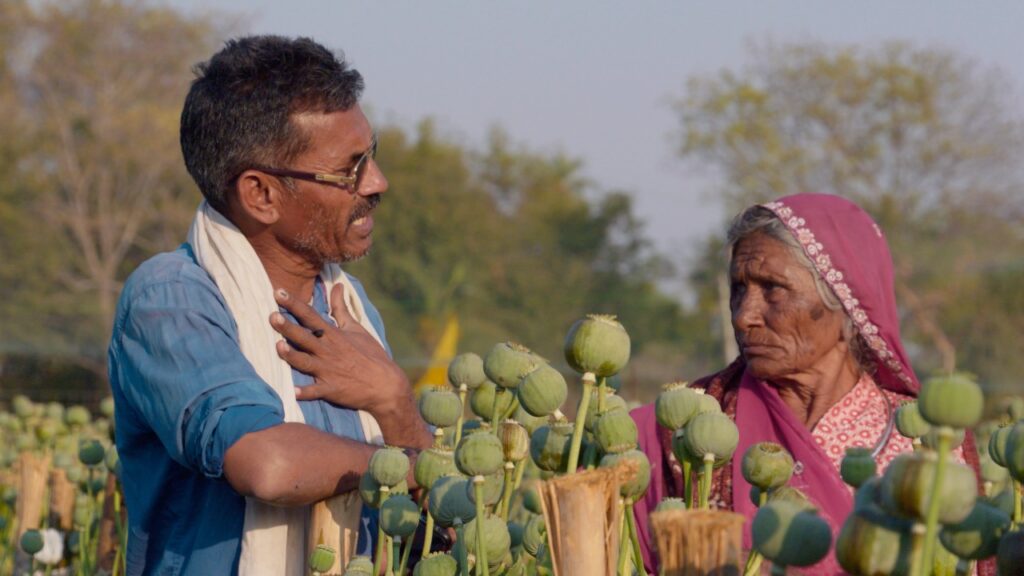
The documentary neither glorifies Mangilal’s resistance nor questions its necessity. What it observes, instead, is the unending cost of the fatigue of endless explanation, the economic precarity that activism does not suspend. Most importantly, the emotional strain of standing apart from a system that punishes visibility. Chaudhary allows these consequences to surface quietly, resisting the temptation to cast Mangilal as either hero or martyr. One of the documentary’s most telling achievements lies in its treatment of “choice.” Within the poppy economy, options are severely limited: farmers comply with corrupt demands, attempt illegal sale, or face financial ruin. Protest exists, but it does not erase the structural imbalance between cultivator and authority. In this context, Mangilal’s resistance is not positioned as an alternative path so much as a refusal to accept the terms of inevitability. The documentary’s title thus resonates ambiguously, as “I” speaks within boundaries that speech alone cannot dismantle.
Caste enters the documentary not as an explanatory footnote but as a lived condition. Vardibai’s references to her Dalit identity are understated, almost incidental, yet they quietly reframe the entire narrative. Corruption here is not merely bureaucratic dysfunction. It is layered atop older hierarchies of exclusion. Chaudhary avoids sociological exposition, trusting the audience to recognise how caste operates precisely through its invisibility within official procedure. In its quiet accumulation of detail, I, Poppy becomes a meditation on the inheritance of land, labour, defiance, and fear. Mangilal is not just a representative but a participant in a system that requires constant negotiation, and Chaudhary’s achievement lies in recognising that dignity here is located not in victory but in endurance.
What distinguishes I, Poppy from many contemporary documentaries on agrarian distress is its refusal to offer a final reckoning or closure. The conclusion signals a commitment to lived reality rather than dramatic satisfaction. As the end credits roll, we are informed that a narcotics officer caught taking bribes is nevertheless set free, despite evidence. In parallel, Mangilal is served a notice by school authorities in an attempt to pressure him into abandoning his campaign. Such disparities point to a system in which institutional wrongdoing is routinely neutralised. Thus, the documentary becomes not only a chronicle of protest but also a record of how power absorbs dissent and leaves its consequences to those with the least protection.
I, Poppy premiered at Hot Docs 2025, where it won Best International Feature Documentary, and went on to receive the Busan Cinephile Award at the Busan International Film Festival.