It is rare to encounter a feature film that renders the brutality of lived experience with the force of actuality. Fewer still derive their power as much from what we hear as from what we see. Kaouther Ben Hania’s The Voice of Hind Rajab is an audio-visual reconstruction of a world poised at the edge of catastrophe. Set against the procedural urgency of the adults who surround her, a little girl’s search for reassurance becomes an ordeal in itself.
The fraught narrative revisits the ordeal of the five-year-old Palestinian girl killed in 2024, when the car in which she was trapped, alongside six dead relatives, came under fire from the Israel Defense Forces in Gaza. Two paramedics were dispatched in an attempt to reach her. The facts, already unbearable, are reassembled with a rigour that resists sensationalism. The film unfolds less as spectacle than as testimony, much of it confined to the procedural claustrophobia of a Red Crescent dispatch room, where language, protocol and hope gradually erode.
Ben Hania shapes the material into an austere acoustic chamber piece about responsibility, distance and the limits of intervention. There are faint echoes of Gustav Möller’s The Guilty in its call-centre setting, though the resemblance is structural rather than tonal; where Möller pursued genre tension, Ben Hania works in the register of testimony. She reconstructs the episode with forensic restraint, eschewing dramatisation for a precise assembly of calls, coordinates and fractured responses, tracing the ethical contours of an already devastating event. In keeping with her interest in the porous boundary between documentary and re-enactment, the form remains severe. Recorded phone exchanges anchor the structure, while the camera lingers on faces taut with dread. Language falters, instructions loop, the line fractures with static. The result is a cinema of austerity in which sound carries a historical and emotional weight.
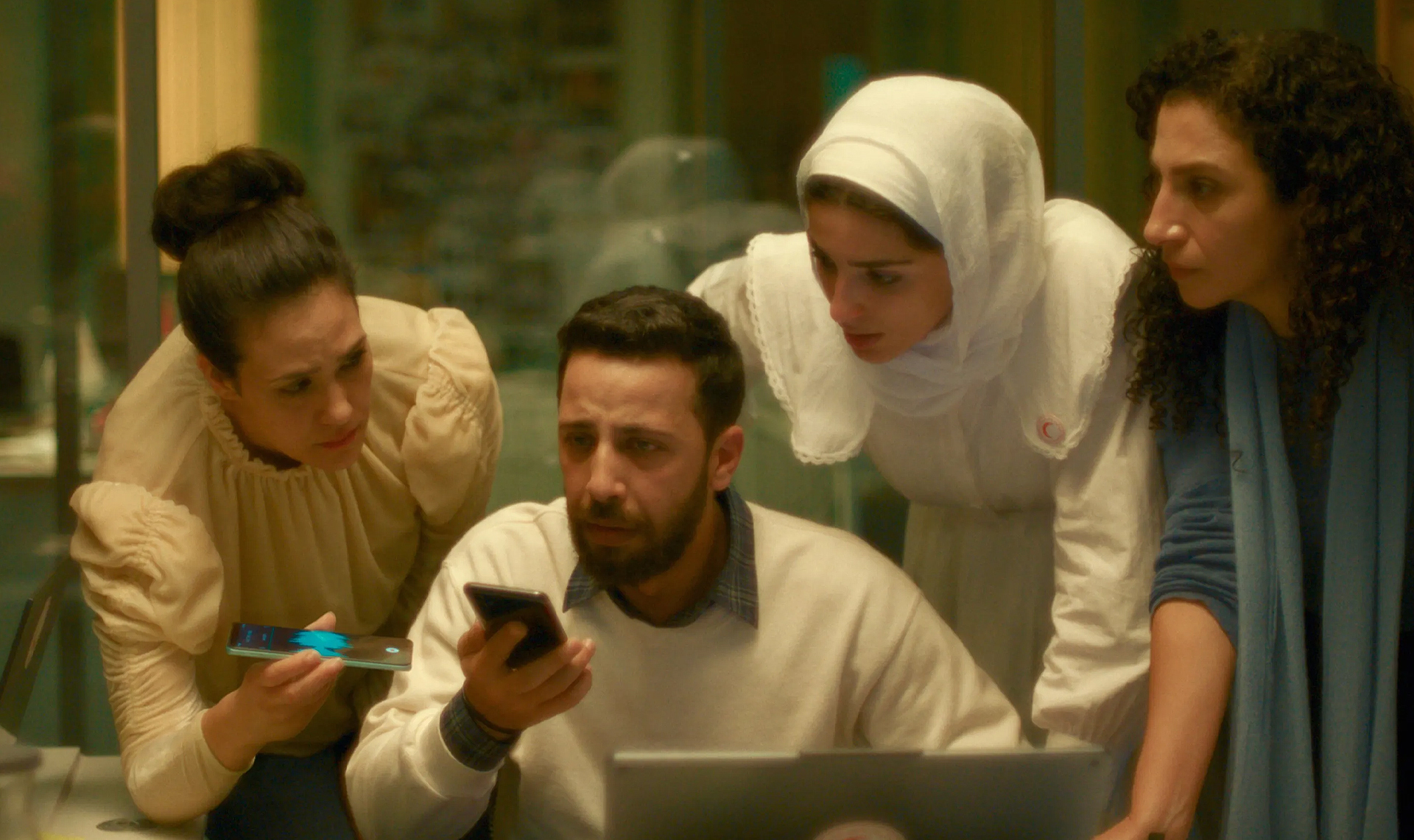
The film opens on an image of deceptive calm: men seated on a bench outside the Palestine Red Crescent emergency call centre in Ramallah, smoking and talking, some 52 miles from Gaza. Within minutes, the stillness is broken. Omar (Motaz Malhees), a dispatcher, answers a call that will test his resolve. A child is trapped in a car that has been attacked. His frustration mounts as he realises that any ambulance dispatch requires military clearance from the very force prosecuting the assault. It becomes a bitter procedural irony. His superior, Mehdi (Amer Hlehel), refuses to breach protocol, having previously lost paramedics in the line of duty. Rana (Saja Kilani) attempts to soothe the girl over the line, while Nisreen (Clara Khoury), too, remains bound by the same regulations. These are individuals caught within a bureaucracy that paralyses even as it seeks to save. At one point, a Google Maps route from the Baptist Hospital to a nearby petrol station is projected onto the wall, eight minutes by car. The distance is negligible, and the impasse absolute.
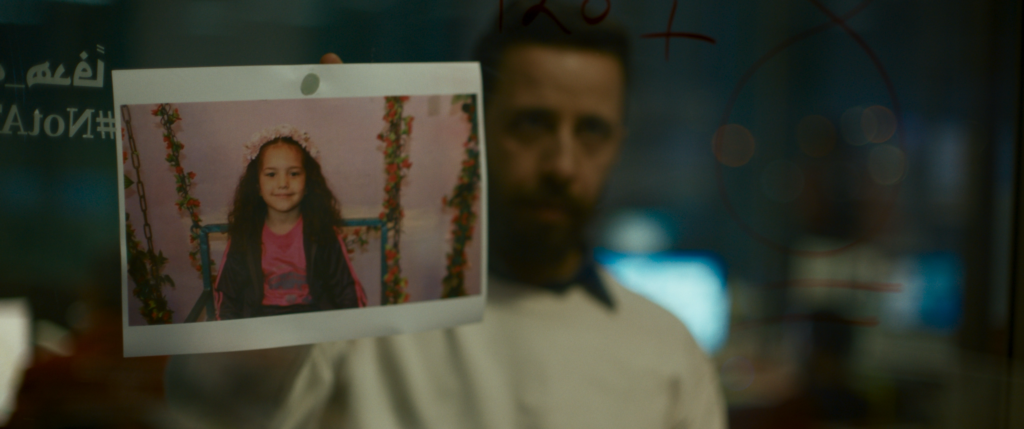
Ben Hania draws on the original phone recordings. The voices are real. Hind is never shown, except in the final moments, when brief footage from her real life appears. The refusal of her image is decisive. It withholds spectacle and compels us to listen. There is no performed pathos. The child’s speech retains its awkward cadences, its repetitions, its small attempts at a cry for help. They are the sounds of someone trying to comprehend disaster as it unfolds. Around her, adult language frays: instructions are repeated with mounting urgency, coordinates checked and rechecked, assurances offered that procedure cannot fulfil. They are the sounds of someone trying to comprehend disaster as it unfolds. What emerges is a stark disjunction between the bureaucratic grammar of emergency protocol and the raw immediacy of fear that resides precisely in that gap between what can be said, and what can be done.
Shot by Juan Sarmiento, the film’s visual field is austere. Much of it unfolds within the tight geometry of cubicles, the camera pressing in close, its handheld tremor echoing mounting agitation. It fixes on rooms, maps and control centres, while Hind’s frightened, digitally thinned voice cuts through the space. The editing by Qutaiba Barhamji, Kaouther Ben Hania and Maxime Mathis maintains a severe rhythmic control, cutting between spaces without manufacturing suspense. Instead, tension accrues through duration and repetition. Sound design by Gwennolé Le Borgne and Marion Papinot insists on the primacy of the aural field. The interplay between the original recordings and the carefully modulated re-enactments produces a layered acoustic texture, where authenticity and reconstruction coexist uneasily.
Across the ensemble, emotion is contained rather than externalised, in keeping with the film’s ethic of sobriety. Motaz Malhees’s Omar registers mounting frustration that never spills into melodrama. The strain is visible in his tightened posture and increasingly clipped tone. Saja Kilani gives Rana a quiet intensity, her brisk exchanges and restless movement within the cubicle betraying an emotional undertow she cannot fully express. Amer Hlehel’s Mahdi appears shaped by prior loss, cautious about breaching protocol even as urgency escalates. Clara Khoury lends Nisreen a composed authority, her stillness suggesting both institutional discipline and suppressed alarm.
Kaouther Ben Hania transforms a chain of recorded exchanges into something approaching a moral reckoning. Whether the shaping of such material risks aestheticising the suffering at its core will remain open to debate. Yet the film proceeds from the conviction that this is a story that demanded to be heard, and, perhaps more importantly, listened to.
At the 98th Academy Awards, The Voice of Hind Rajab was nominated for Best International Feature Film.