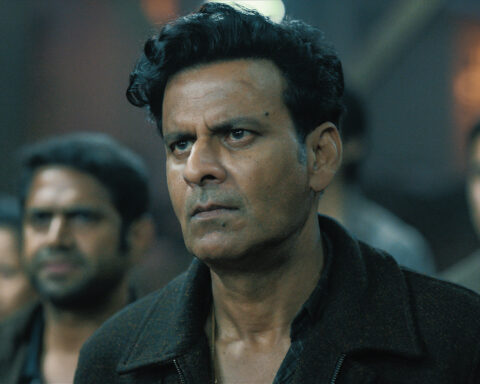
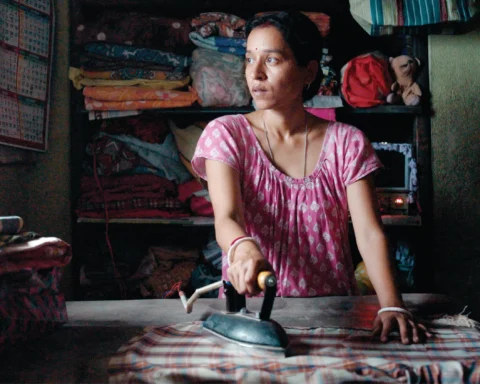
Raam Reddy’s sophomore feature Jugnuma (The Fable, 2025), which screened in the Encounters section of last year’s Berlin Film Festival, establishes itself through a visual aesthetic that transports the viewer into an entirely new realm. Its quiet moments speak volumes, marked by a penchant for the lyrical. The film invites us into an intimate and meditative world, where the personal is never merely anecdotal but serves as an anchorage for a drama that gestures towards the complex, mythic dimensions often associated with magical realism.
Set in the spring of 1989, Jugnuma unfolds in an old colonial house perched high on a Himalayan ridge, where Dev (Manoj Bajpayee) resides with his wife Nandini (Priyanka Bose) and their young son Juju (Awan Pookot). Their teenage daughter Vanya (Hiral Sidhu), away at boarding school, makes an unexpected visit, completing the picture of a household that appears self-contained, almost idyllic. Mohan (Deepak Dobriyal), Dev’s loyal estate manager, assists in overseeing the sprawling fruit orchard that sustains them. One morning, when Dev stumbles upon a charred tree on the estate, the pastoral calm gives way to unease. Despite his desperate efforts to contain the threat, the devastation only deepens, casting a long shadow over the harmony of his household.
The film’s opening immediately establishes Dev’s ritual. Each morning, he retreats to his workshop, fastening the vast wings he has painstakingly constructed before leaping from the cliff to soar across the valley. This eccentric act reflects a deeper sense of order that carries into his domestic life, where, with his wife and children, Dev fosters a liberal and egalitarian spirit. In one of the film’s most affecting scenes, the family lie on the ground at night, gazing at a sky ablaze with stars and tracing constellations with playful intimacy. The moment is tender, but it also resonates thematically, suggesting the film’s wider interest in how the personal remains tethered to larger, cosmic forces.
Yet this seemingly harmonious existence is carefully insulated. Dev is attentive to his employees who are local hill residents of humbler backgrounds. But there remains a perceptible distance shaped by education and class. His dinner guests, urbane and modern, bear the unmistakable imprint of a colonial hangover still lingering in manner and outlook. It is within this self-contained, almost hermetic world that the first discovery of a charred tree unsettles the rhythm of his life. The pattern of destruction that follows destabilises not only Dev’s authority but also the social hierarchy he has come to rely upon. As suspicion falls upon his employees and passing nomads, the film probes the dynamics of class, privilege, and distrust with a restraint that avoids overt didacticism.
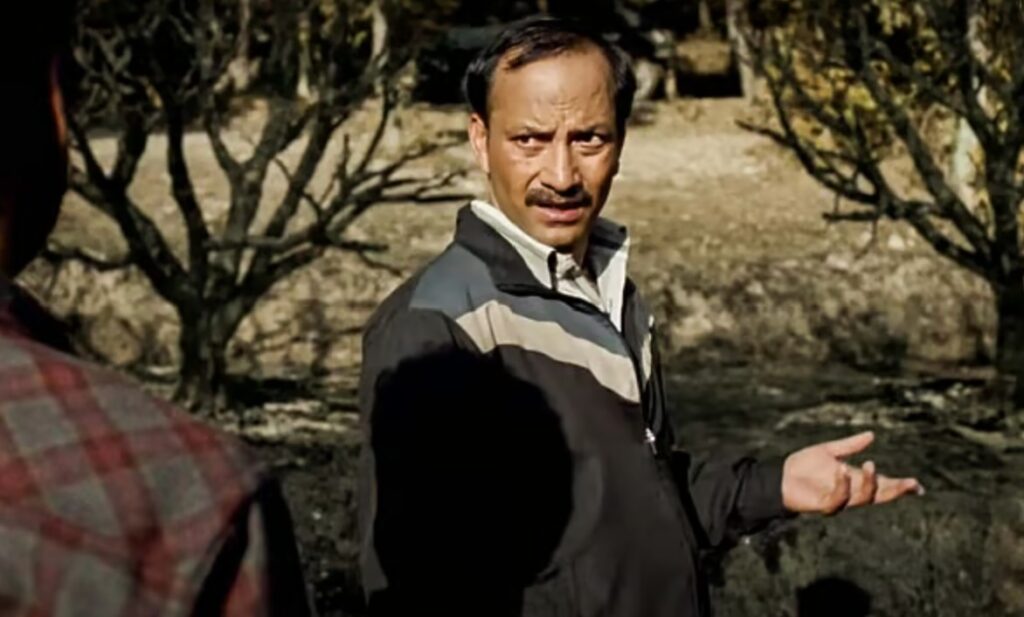
The film deepens its hold through the unhurried unfolding of its characters, each thread reinforcing Reddy’s broader poetic vision. Nandini’s classical singing is more than melodic relief. It becomes a soothing assertion of calm amid the encroaching rupture. Vanya, caught in the tremors of adolescent desire, is drawn to a young nomad whose sensual, spiritual aura embodies both longing and danger, while Juju’s restless vitality enlivens the household’s tender balance. The allegorical register surfaces in Radha’s (Tillotama Shome) bedtime tale of celestial beings living among mortals, mirroring the film’s own fusion of myth and everyday life. In contrast, the opportunism of Mr. Singh (Rampal Kishore Agarwal), a government official exploiting the crisis, grounding the story in worldly corruption. Together, these strands shape a universe at once tethered and open to metaphysical speculation.
This interplay between the intimate and the structural is central to Raam Reddy’s storytelling. As in Thithi (2015), where rural absurdities masked sharp social insight, Jugnuma grounds its drama in everyday gestures that gradually reveal deeper tensions. Reddy avoids exposition, relying instead on atmosphere and rhythm to shape meaning. What distinguishes him here is his refusal to simplify. The narrative inhabits a register where mythic symbolism coexists with sociological observation, producing a tone at once meditative and unsettling. The fireflies serve both as a narrative catalyst and as a visual metaphor for fragility of land, of community, and of the tenuous balance Dev has constructed around himself.
Shot on 16mm by Sunil Borkar, the cinematography evokes the period with a tactile grain that feels like memory etched onto celluloid. Siddharth Kapoor and Reddy’s editing shapes this density into a rhythm that balances immersion with reflection. Nithin Lukose’s sound design, attuned to Reddy’s vision, makes silence as resonant as noise, where each echo or rustle amplifies the film’s atmosphere and sense of brooding.
Manoj Bajpayee as Dev is defined by a quiet magnetism. He embodies a man of order and restraint, exuding calm authority even when crises unfold around him. Surrounding him, Deepak Dobriyal as Dev’s manager, Priyanka Bose as his wife, and Hiral Sidhu as his daughter offer performances that are understated yet deeply attuned to the film’s tonal fabric. Tillotama Shome as Radha, leaves a lingering impression with a performance that is brief but incisive, hinting at unspoken parables. Complementing these seasoned actors are the non-professional performers, whose unvarnished presence roots the film in its lived textures.
The Fable is a carefully woven meditation on continuance, desire, and transcendence. Reddy resists easy resolutions, instead leaving us suspended in a state of quiet wonder, much like his characters, caught between the earthly and the otherworldly. It is a film that lingers, not for what it declares, but for the spaces it opens up within us.